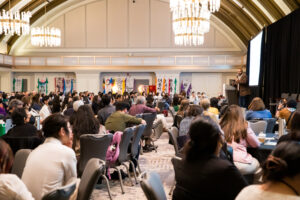
Report Back from Chicago

March 17th, 2009

The partners haven’t done a complete debrief yet, so I’ll be sharing a quick summary of the event in a later post. Long story short: our outreach efforts were a success! Although many of us there were saddened at the long line–at one point the line reached around the block of the Orozco Academy–we were glad to see that they were willing to overcome any embarrassment or shame and come to the event to received education, counseling, and hopefully a solution.

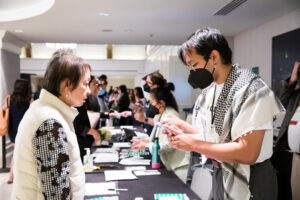
I had promised photos earlier, and I hope I don’t disappoint! I didn’t take any pictures of the fair when it was full swing, since I was feeling very conscious of the fact that many times families from our communities are very much reluctant in having their pictures taken at these sorts of events. Nevertheless, I hope you enjoy the pictures of the Korean American Resource and Cultural Center office in the north side of Chicago, as well pictures of the set up!  I wish I had more time to get more pictures of the folks involved in organizing this event, but I’m afraid my pictures will have to suffice for now.

From L to R: myself, Kristen (the Resurrection Project), Romana, Chloe (KRCC)

From L to R: myself, Kristen (the Resurrection Project), Romana, Chloe (KRCC)

Greetings from Chicago!

March 13th, 2009

If you’ve been perusing around this blog and the social networking site, you may have noticed that many of the things I post are on foreclosures. That isn’t to suggest that foreclosure mitigation is the entirety of my work or interests–I hope to blog more on other things–but it has been taking up a lot of mental space.

Why, you ask? Well, National CAPACD has been working with the National Urban League and the National Council of La Raza on focusing the foreclosure mitigation efforts for communities and homeowners of color. While this has been an informal multicultural effort for a good part of 2008, Bank of America has approached the three organizations with an offer to formalize the coalition work under the name of Alliance for Stabilizing our Communities.

The three national groups are kicking off the Alliance with a home retention/rescue fair in Chicago, in partnership with some of our local member organizations. The Korean American Resource and Cultural Center, the Chicago Urban League, and the Resurrection Project (NCLR affiliate) are working together to bring culturally and linguistically competent homeownership education and home retention information to the communities of Chicago. At National CAPACD, I and many of us on staff have spent a lot of time coordinating with the other organizations involved, and I can tell you that we are very excited to see this event launched.

So, Romana and I are in Chicago right now to support KRCC in this event–please check back to the blog and the social network site for pictures of our Chicago members and a report back from the event!

I’d also like to note that this is just another example of the cross-cultural/ethnic efforts that our members are engaging here, especially in Chicago; another one of our Chicago member groups, the Chinese American Service League, is working in conjunction with the Resurrection Project to build additional affordable rental housing here in the Windy City.  Unfortunately it looks like Romana and I won’t have time to visit the site or CASL during this visit, but for those of you in Chicago–please feel free to join the social networking site and share pictures! [Actually, that goes for everyone:  join! share pictures! ]

Have you checked out the National CAPACD Social Network?

March 10th, 2009

It’s great that you’re coming to read the blog, and I encourage you to keep on doing so!

But, have you checked out the National CAPACD Social Network?  Many people in the CAPACD network have already set up profiles and are getting active on there.   You can connect with amazing experts in the community development field like Grant Din, National CAPACD Board member and non-profit consultant.  Or you can touch base with Jamie Tse, a senior member of A-VOYCE (the youth development program of Asian CDC) who is connecting her passion for the arts with community development in Boston’s Chinatown.    Leave a message for National CAPACD Official Blogger and Public Policy Manager at Chinatown CDC, Malcolm Yeung and share your thoughts on neighborhood activism.  Check out the discussion forums as more information comes to light around the foreclosure crisis.

There are so many opportunities to connect with National CAPACD members and share information on best practices.   Set up your profile today!

On Chinatown

March 2nd, 2009

I’m a first generation Chinese American who grew up Houston, Texas.  I went to college on the East coast (Southeast that is, don’t confuse me with the “Back East” crowd) to get away from my “traditional” Chinese parents.  I majored in Organic Chemistry like all good pre-med Asians, made a quick stop over in Colorado to pick up a masters in history, volunteered a stint with Americorps, and then worked in bike shops.  When I “grew up,” I had a brief taste of the good life as a suit wearing, big buck lawyer at a fortune 500 law firm in San Francisco.  So how in the world, people ask me, did I end up being a neighborhood activist in San Francisco Chinatown?

To answer that question, I’d recommend that anyone who visits San Francisco take a tour of our Chinatown.  But don’t get sucked into just any tour.  Take the tour run by the Adopt an Alleyway (AAA) Youth Program.  Sure, the youth who run the tour will tell and point you to the typical tourist stuff –like how Chinatown was the first concentration of Asian Americans in America, was run by historic family associations who ran the community for over a century, and houses the distinctly “Chinese” looking architecture that emerged after the 1906 earthquake as a way of “saving” the community for the Chinese.


But, if you want to learn a little more, peer behind the veil constructed by the tourist industry, they’ll answer questions about a community that is far more than a historic relic.  They’ll point you to a living, breathing, evolving community that serves thousands of low-income immigrants, a community that houses seniors and families, a community that is a literal gateway for newer arrivals trying to get their footing.  They can point you to a community that contains the City’s largest stock of affordable housing units – in the form of single room occupancy “SRO” hotels that are, all too frequently, occupied by entire families, a community that is so dense, that alleyways often serve as the best source of open space for children to play in, and a community that is one of the few places that monolingual immigrants can find in-language and culturally appropriate health care, social services, and jobs.


The fact is, San Francisco Chinatown lies at the center of Chinese American life, and not only for the low-income immigrants who choose to live there.  Chinatown is also the historic and I’d argue present “capital” of Chinese America in the Bay Area (and we’d like to think beyond . . .).  Its impact extends beyond San Francisco as its many “emigrants” frequently return “home” for a dose of “soul food,” Church and temple, Chinese school for kids, and lion-dancing lessons.  Chinatown is also a locus of political power, a literal base from which Chinese Americans can organize a “base” to hold local, state, and even national politicians accountable to the needs of this specific community and, sometimes, even the broader needs of “Chinese America.”


But Chinatown is also an anomaly in the physical landscape of San Francisco and under constant threat.  Viewed from on high, it is a literal hole in the landscape – a depression of low-rise, historic “looking” buildings surrounded by modern office skyscrapers, luxury condo high-rises, and high rent flats that dot the bordering hills.  As it turns out, Chinatown lays right smack dab in the middle of some of this country’s most expensive real estate.  Real estate speculators salivate over the “potential” earning power of Chinatown and fervently believe that the underlying land is too valuable for its existing community based use.  They dream of “flipping” its SRO hotels and transforming them into high-rise towers reminiscent of Shanghai or Hong Kong.  Under this constant pressure, the preservation and strengthening of Chinatown (and places like it) have been and must continue to be an intentional, concerted act.


Spaces like Chinatown would not exist if it were left solely up to the market (even in these ailing economic times).  For Chinatown and ethnic gateways like it to continue to exist, for it to continue to serve low-income, monolingual immigrants families and seniors, and for it to serve as the locus of the cultural and political institutions that make up and identify Chinese America – it must be fought for, struggled over, defended, and expanded.  In moments of opportunity, this can be done proactively by implementing community wide “area plans” like San Francisco’s 1986 Chinatown Rezoning effort (that is largely responsible for the present physical geography of the neighborhood).  At other times, it must be defended through “street level” activities like protests and eviction defense on a block by block, building by building, unit by unit, and brick by brick basis.  In the coming weeks and months, I’m hoping to write more about these local struggles that, I believe, have broader regional, state, and national implications.  And that, is why I am a Chinatown activist.

Housing Blogs

February 26th, 2009

There are a variety of blogs out there on many topics. Of particular interest to National CAPACD members would be some of the housing blogs I’ve found.

The National Housing Institute, publishers of ShelterForce Magazine, has started their own blog called Rooflines.

The National Housing Conference’s blog Open House “focuses on the most current and critical issues facing the housing and affordable housing community”.

Then there’s the Housing Finance Blog, which provides a different perspective than the non-profits.

If you know of other good blogs that the National CAPACD network should be reading, let us know!

Foreclosure Moratoriums

February 17th, 2009

Interesting news from two major mortgage lenders:  Citi will be placing a moratoriums on foreclosures for mortgages of owner occupied single family units, while Freddie Mac will be extending its moratorium on foreclosures for single and 2-4 unit properties.   Citi’s moratorium is clearly more geared towards homeowners, while Freddie Mac’s is geared to both homeowners and renters of foreclosed homes.  Many times renters of foreclosure properties have no idea that their apartment is facing foreclosure until the eviction notice comes.

The questions that come to mind are:  how successful has Freddie Mac been when it comes to managing all of these rental properties?  How feasible is it to do this in the long term? While neither lender is proposing this, the fact that this is an extension of a previous moratorium by Freddie Mac suggests that this is a stop-gap measure while the entire industry is trying to figure things out.  Nevertheless, this may have been more effective six months ago, when sub-prime mortgages were seen as the primary culprit, but what about now, when unemployment rates are reaching new highs?

What are your thoughts on this?  How is this affecting your neighborhoods?

Of course, there are many other venues to share your organization’s experience with these issues:  KnowledgePlex will be hosting an online chat to introduce a new website, Foreclosure-Response.org.  The website looks to be another opportunity for community organizations to solicit advice or share best practices on foreclosure mitigation and neighborhood stabilization.  If you scroll down on that website, you’ll see that KnowledgePlex will be hosting another online chat to introduce HousingPolicy.org, which will be an opportunity to share ideas on affordable housing policy.  The moratoriums will only last so long and can only do so much, so hopefully the discussions both here at National CAPACD’s blog (and soon to be launched social networking site!) and KnowledgePlex’s sites can lay the groundwork for long-term solutions.

These sites are meant to be a forum for folks on the ground, so if you can attend a chat, please don’t be shy about giving feedback–these websites are for you!

Asian Subpopulations Lack Adequate Health Coverage

February 10th, 2009

I really enjoyed this article on AsianWeek, because it lays out the same story that National CAPACD is trying to tell.  If you disaggregate the data, you will find that the “model minority myth” doesn’t hold true for many Asian American subpopulations throughout the country.

Just as we have seen in the foreclosure crisis where certain communities are disproportionately facing foreclosures (This includes the South Asian community in Jackson Heights, the Southeast Asian communities in Minnesota and the Central Valley of California, and the Philipino community in California), this AsianWeek article outlines similar problems within the health field.

National CAPACD and the APIA Health Forum have already recognized the overlap between community health and community development.  As a matter of fact, we are working together to bring these issues together as part of our conventions on June 3, 2009.

Stay tuned to National CAPACD’s website for more updates on this and our convention!

“Being There” By Reverend Norman Fong

February 4th, 2009

The following is an article written by Reverend Norman Fong, Deputy Director of Programs at Chinatown Community Development Corporation in San Francisco.

When Lisa Hasagawa, the ED of National CAPACD, invited me to the Presidential Inauguration in Washington DC, I almost fell off my seat! She said: “You have to be here – it’s history! On my connecting flight to Dulles (IAD) from Atlanta, I sat next to a young African American student who had never been on a plane before… She had no inaugural tickets… She just wanted to “Be There!” like 2 million others to witness the inauguration of the first US President of Color!

The inauguration was inspiring and the words, prayers & songs were moving… but the real miracle was simply the coming together of so many people who had renewed hope in civic engagement and social change. From where Lisa Hasagawa and I stood, one could see movie stars like Oprah to Jamie Fox walking in… and when Aretha sang, I was movin’ to the groovin’!

At the Pearl Gala (API inaugural ball), it was empowering to see so many API leaders, celebrities, movers & shakers like Dr. Steven Chu (Secretary of Energy); Eric Shinseki (Secretary of Veterans Affairs), Senator Daniel Inouye, Congressman Mike Honda (who still calls me “Rev”); Actress Kelly Hu; and hearing Maya Sotero Ng and Konrad Ng (the sister & brother-in-law of President Obama) speak… More than just “being there”, it was clear that the API Community was now – finally there “at the table”…

Getting community voices to the table, to the halls of City Hall and all the way to the White House … well, that’s an affirmation of CCDC’s mission of empowerment & civic engagement. On the plane ride home, I sat next to a woman from Senegal who in tears said it was so worth just being there… She said “My son – only 3 years old – upon seeing the new President shouted: “He’s brown like me!” All of us can celebrate the inauguration of a new day when the walls of division are torn down and all are invited “to the table”.

Pre-purchase help for homebuyers lessens risk

January 22nd, 2009

As many a homeownership counselor will tell you, pre-purchase counseling plays a huge factor in determining an individual’s risk of foreclosure.  Many homeownership counselors have said that the individuals they counseled did not end up in sub-prime or Alt-A loans.   The San Francisco Chronicle confirmed that by covering a story about the Mission Economic Development Agency (MEDA).  Jane Duong, MEDA’s homeownership program manager, was quoted in the story, and she has also spoken at several National CAPACD conferences, and she is currently an advisor to the National CAPACD California Network.

Asians in Florida and California Burdened by Foreclosures

January 21st, 2009

Monterey County Herald published an interesting article about the linkage between minorities and foreclosure rates.  The Associated Press has conducted research that shows that “one out of five of the nearly 52 million homeowners with a mortgage spend 38 percent or more of their pre-tax income on their mortgage payment, property taxes, and insurance”.

In addition, more than 30 percent of Asian borrowers in California and Florida spend at least 38 percent of their income on housing, leaving them with very little cushion for medical and family emergencies.

Full article can be seen here.